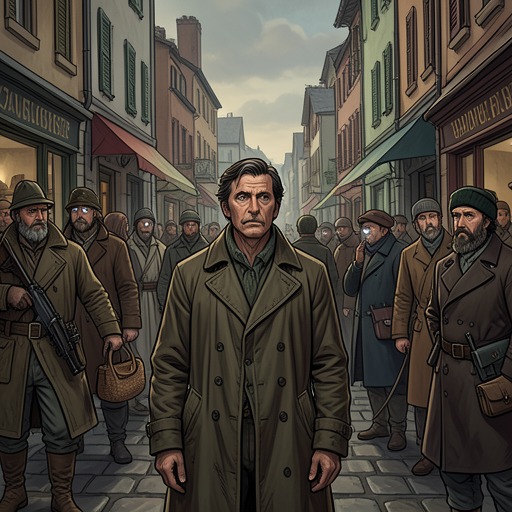
Chifoilisk
The DispossessedChifoilisk is a Thuvian physicist and agent of his country’s government, encountered by Shevek during his visit to Urras. Stocky and middle-aged, with a swarthy face, short iron-grey hair, and a bristling chin, he is the sharpest political realist among the scientists surrounding Shevek. His importance lies in making explicit what the hospitality of A-Io conceals: the visitor’s welcome, scientific freedom, and access to publication are entangled with state power and economic interest. Yet Chifoilisk’s own alternative is not disinterested internationalism; it is loyalty to Thu.
Arrival and First Impressions
Chifoilisk is introduced among the visitors who come to see Shevek after his arrival in A-Io. Shevek recognizes him as one of the men he had met the previous evening, and the two greet each other across a cultural divide: Shevek embraces the elderly physicist Atro in the familiar manner of Anarres, while Chifoilisk stands among the Urrasti visitors in their formal, polished surroundings. His coarse face and desk-worker’s hands distinguish him from the more carefully presented men around him, and his manner is immediately less conciliatory than theirs.
When the group discusses Shevek’s estrangement from Sabul, Chifoilisk dismisses the idea that Odonian society is free of rivalry. He describes Sabul as an older rival who interfered with Shevek’s books, and rejects the presumption that Odonian comradeship makes ordinary human conflict disappear. His remark is less an account of Sabul than an early statement of his own governing assumption: political and personal interests persist beneath any society’s declared ideals.
Chifoilisk also punctures the reassuring language of hospitality. When Atro and Pae insist that Shevek is a guest and owes nothing for the clothes and necessities arranged for him, Chifoilisk adds that the Ioti Government is paying the bill. The detail shifts the exchange from personal generosity to public sponsorship, making visible the state behind the welcome. Later, when Pae raises concern about Shevek’s health, Chifoilisk pointedly asks whether the doctor is from the government, voicing suspicion of official care even as Atro defends the physician.
The Political Meaning of Hospitality
Chifoilisk’s suspicion becomes direct during a conversation in the library. After Shevek explains that he has asked the government doctor to send the treatment for his dust cough to the Syndicate of Initiative on Anarres, Chifoilisk responds with a sardonic grunt. In the firelit reading room, he tells Shevek that he wants to be disagreeable, then asks whether Shevek understands that he has been bought. He recasts the visitor’s comfortable room, lectures, students, research facilities, and tours as benefits provided by a capitalist state with interests of its own.
Shevek does not deny that exchange has a political price. He answers that he came to bargain with the system, seeking free exchange between Anarres and Urras and the end of their isolation. He wants solidarity across the divide, not merely personal advancement or better treatment for himself. Chifoilisk understands the danger in this ambition, but interprets it through the competition among states: he warns that Shevek’s habit of approaching people as individuals prevents him from seeing the powers operating behind them.
That warning has a concrete basis. Chifoilisk tells Shevek that Pae is an ambitious, loyal agent of the Ioti Government who reports to the Department of National Security, and that Shevek’s room, like Chifoilisk’s, contains a concealed microphone. Pae’s agreeable manner therefore has a second function as political surveillance. Chifoilisk insists that Shevek must distinguish the person he meets from the institution that uses him, a lesson at odds with Shevek’s effort to make human relations themselves the basis of political change.
Patriotism and the Limits of Solidarity
Chifoilisk reveals that he, too, is an agent. He says that Thu sends abroad only men it can trust, and that he believes in his government and country. His declaration is strained rather than triumphant: he speaks with hatred and apparent torment as he insists that he has not been bought by the wealthy Ioti professors. He identifies as a socialist whose country shares a revolutionary inheritance with the Odonian movement, and argues that Thu is closer to Odonianism than A-Io is.
But the difference between his professed socialist sympathies and his national loyalty becomes unmistakable when he explains what he would do to obtain Shevek’s theory. If he had known it existed in written form, he says, he would have tried to secure it by persuasion, theft, or force, so that it could be taken from A-Io’s capitalists and placed in the hands of Thu’s Central Presidium. He names the strength and welfare of his country as the highest cause he can serve. Shevek believes that Chifoilisk would not actually betray him, because he sees in him a respect for scientific truth and for individual people; Chifoilisk answers that he would if he could. Their disagreement exposes both Shevek’s faith in personal ethical limits and Chifoilisk’s willingness to subordinate those limits to national purpose.
Chifoilisk nevertheless warns Shevek against giving his theory to A-Io. He urges him to go to Thu if he finally understands what is happening, and, failing that, at least to withhold his work from the Ioti. He tells Shevek to leave and give his people what he has to give. Shevek replies that they do not want it and that he has already tried. Chifoilisk departs for Thu four or five days later, leaving the warning unresolved rather than converting it into an alliance.
Shevek’s Theory as a Gift
Chifoilisk’s conflict with Shevek reaches beyond the question of which government should possess a scientific discovery. Shevek rejects both sale and national appropriation, asking whether giving is possible as an alternative. He wants to share his theory with Keng, Hain, and the countries of Urras so that no one state can use it to gain power, wealth, or advantage in war. This purpose differs fundamentally from Chifoilisk’s proposed transfer to Thu’s Central Presidium: even when Chifoilisk opposes A-Io’s profiteering, he still imagines the theory as an instrument of his own country’s strength.
The contrast clarifies Chifoilisk’s narrative role. He is not simply wrong about A-Io: his account of state sponsorship, surveillance, and political calculation helps Shevek see the structures obscured by individual courtesies. Nor is his warning equivalent to Shevek’s ethic of common access. Chifoilisk recognizes the danger of allowing A-Io to control the theory, but his answer reproduces the contest for possession by proposing a different national owner. Against that logic, Shevek’s offer treats knowledge as a gift intended for common use, not a prize to be sold or captured. Chifoilisk’s uneasy candor therefore sharpens the choice at the center of Shevek’s visit: whether scientific truth will serve a state, or be shared beyond the rival claims of states.